Project title: Conservation and restoration of degraded insular biodiversity: impacts of the removal of introduced mammals on the dynamics of infectious diseases in seabirds across islands of the Southern Ocean
Context
Invasive species are one of the main threats to biodiversity, and species most susceptible to invade inhabit marine islands which were home to >90% of the bird species that have gone extinct over the last 500 years. Island ecosystems are unique and particularly vulnerable to invasive species, disease spread and other threats. Relatively recently, a momentum has been building worldwide to control the spread of introduced species, develop protocols to decrease the risk of introducing new species, and, when possible, eradicate invasive alien species. In the Southern Ocean, the impact of these threats on Antarctic and sub-Antarctic terrestrial ecosystems is particularly exacerbated by environmental change. Ambitious restoration projects based on the eradication of introduced mammal species from islands (such as rats, mice and cats) are being implemented, but they very rarely consider the potential role of pathogens as a threat to native seabirds, despite their potential importance. In this context, project REMOVE_DISEASE aims at exploring the impact of the eradication of introduced species on the dynamics of pathogens and biodiversity on islands.
Main activities
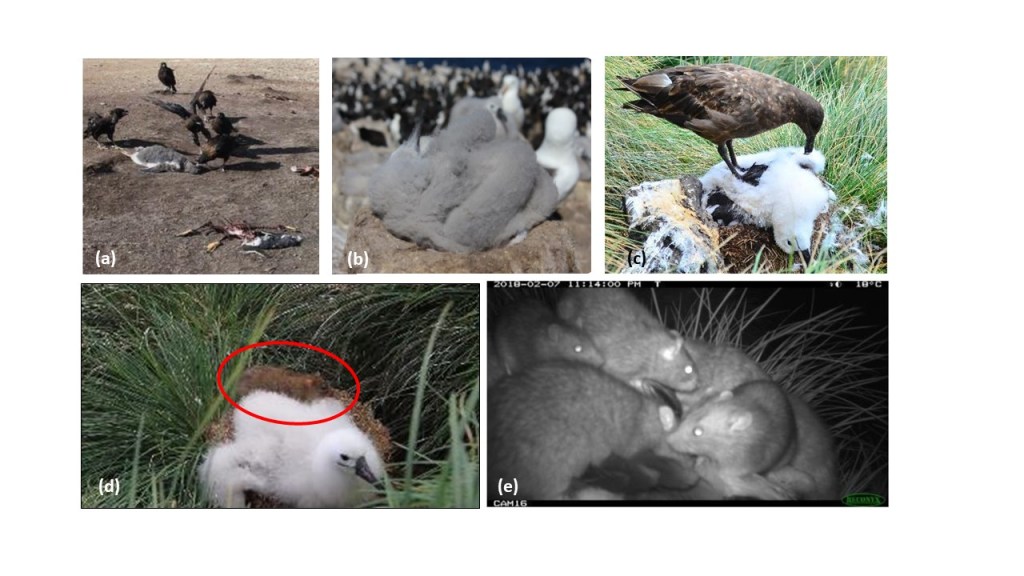
In densely breeding species, such as seabirds, the threat posed by pathogens is increasingly recognised, and in some cases introduced mammal species are suspected to be playing key roles as maintenance reservoirs or vectors of transmission, such as on Amsterdam Island, in the south of the Indian Ocean, where yearly epizooties of avian cholera kill thousands of nestlings. Records of infectious diseases of seabirds have been reported on other islands, where they could contribute to threaten host species. In this project, we aim at exploring the effects of the eradication of introduced mammal species on the dynamics of exposure of native seabird species to infectious agents on islands. Moreover, we will explore the mechanisms by which those changes may occur and their potential long-term implications. By including avian scavengers as sentinel species in epidemiological surveys pre- and post-eradication, we will maximize our ability to detect effects. In parallel, we will investigate how consideration of these epidemiological aspects could benefit the implementation of large-scale biodiversity restoration projects. REMOVE_DISEASE will benefit from interdisciplinary approaches, independently funded restoration efforts, and from being conducted on islands that have been the subject of detailed monitoring and conservation biology studies by the international partner teams.
Outcomes and expected impacts
The test of the eco-epidemiological impact of introduced mammal eradication plans on eco-epidemiological dynamics will directly benefit from being conducted in anticipation and in parallel with the management plans to restore the ecosystems. The outcomes of REMOVE_DISEASE will further have relevance for inverse zoonoses, i.e. the transmission of infectious diseases from humans to wild animals, which has specifically been identified as an important risk in southern polar areas in the case of enterobacteria and coronaviruses. The four stakeholders partners the National Nature Reserve of the French Southern Lands, Bird Life International, Falklands Conservation and Bird Life South Africa, will be engaged via their involvement in the project meetings, the coordinated planning of fieldwork, and the interpretation and dissemination of the results. Each eradication project costs much, so the explicit consideration of the possible extra benefit of eradicating infectious disease may be of critical importance. The study will be conducted in polar contexts, with relatively simple systems (few species), but the results will be of importance for eradication of introduced mammals on islands worldwide, including in temperate and tropical ecosystems.
Project contribution to policies and / or society
The findings could highlight how the eradication of introduced species from islands can directly benefit the conservation of biodiversity by relieving native species from predation pressure from those species, but also indirectly via its effect on disease agents. This is especially important in the current context of global change, with potential increased risks of infectious disease spread and emergence. Stakeholders involved as partners are a government environmental agency (the National Nature Reserve of the French Southern Lands) and non-governmental organisations (BirdLife South Africa, Falklands Conservation, and BirdLife International) that are critically involved in biodiversity conservation. The direct involvement of stakeholders in an international setting will contribute to achieving the objectives of the project and its broad implications.
Impact of the panzootic of high pathogenicity avian influenza
With the broad emergence of high pathogenicity avian influenza (HPAI) in wild species in 2022, the spread of the virus in 2023 in subantarctic and antarctic areas, and it arrival in the 2024 austral summer in the southern Indian Ocean (Clessin et al. 2025), the teams involved in REMOVE_DISEASE project have been mobilised to respond in various complementary ways to the HPAI crisis. Our long term involvement in seabird population ecology at three key sites for the spread of the virus in south polar areas,, the Falkland Islands, Marion Island, and the French Southern Lands, indeed putted us in a unique position to contribute to respond to the crisis. Coordinated field work on disease ecology issues at multiple sites and on multiple host species in the framework of REMOVE_DISEASE has been important to provide timely results since the beginning of the HPAI panzootic (Lisovski et al. 2024, Clessin et al. 2025, Lejeune et al. 2026).
Selected recent publications of the partners relevant for the project prior to its implementation:
Beal M, Dias MP, Phillips RA, Oppel S, Hazin C, Pearmain EJ, (…) & Catry, P. 2021. Global political responsibility for the conservation of albatrosses and large petrels”. Science Advances 7: eabd7225.
Boulinier, T., Kada, S., Ponchon, A., Dupraz, M., Dietrich, M., Gamble, A., Bourret, V., Duriez, O., Bazire, R., Tornos, J., Tveraa, T., Chambert, T., Garnier, R. & McCoy, K.D. 2016. Migration, prospecting, dispersal? What host movement matters for infectious agent circulation? Integrative and Comparative Biology 56: 330-42.
Bourret, V., Gamble, A., Tornos, J., Jaeger, A., Delord, K., Barbraud, C., Tortosa, P., Kada, K., Thiebot, J.-B., Thibault, E., Gantelet, H., Weimerskirch, H., Garnier, R. & Boulinier T. 2018. Vaccination protects endangered albatross chicks against avian cholera. Conservation Letters 11: e12443.
Brooke, M.de L., Bonnaud, E., Dilley, B.J., Flint, B., Holmes, N.D., Jones, H.P., Provost, P., Rocamora, G., Ryan, P.G., Surman, C. and Buxman, R.T. 2017. Seabird population changes following vertebrate eradications on islands. Animal Conservation 21: 3-12.
Connan, M., Dilley, B.J., Whitehead, T.O., Davies, D., McQuaid, C.D. & Ryan, P.G. 2019. Three dimensional stable isotopes inform on resource partitioning in an island bird community. Ecography 42: 1948-1959.
Dias, M., Oppel, S., Bond, A.L., Carneiro, A.P.B., Cuthbert, R.J., Gonzáles-Solís, J., Wanless, R.M., Glass, T., Lascelles, B., Small, C., Phillips, R.A. and Ryan, P.G. 2017. Using globally threatened pelagic birds to identify priority sites for marine conservation in the South Atlantic Ocean. Biological Conservation 211: 76-84.
Dias, M.P., Martin, R., Pearmain, E.J., Burfield, I.J., Small, C., Phillips, R.A., Yates, O., Lascelles, B., Borboroglu, P.G. & Croxall, J.P. 2019. Threats to seabirds: a global assessment. Biological Conservation 237: 525-537.
Gamble, A., Garnier, R., Jaeger, A., Gantelet, H., Thibault, E., Tortosa, P., Bourret, V., Thiebot, J.-B., Delord, K., Weimerskirch, H., Tornos, J., Barbraud & Boulinier, T. 2019. Exposure of breeding albatrosses to the agent of avian cholera: dynamics of antibody levels and ecological implications. Oecologia 189: 939-949.
Gamble, A., Bazire, R., Delord, K., Barbraud, C., Jaeger, A., Gantelet, H., Thibault, E., Lebarbenchon, C., Lagadec, E., Tortosa, P., Weimerskirch, H., Thiebot, J.-B., Garnier, R., Tornos, J. & Boulinier, T. 2020. Predator and scavenger movements among and within endangered seabird colonies: opportunities for pathogen spread. Journal of Applied Ecology 57: 367-378.
Gamble, A., Garnier, R., Chambert, T., Gimenez, O. & Boulinier, T. 2020. Next generation serology: integrating cross-sectional and capture-recapture approaches to infer disease dynamics. Ecology 101: e02923.
Gomard, Y., Lagadec, E., Humeau, L., Pinet, P., Bureau, S. & Da Silva, D. 2019. Feral cats do not play a major role in leptospirosis epidemiology on Reunion Island. Epidemiology & Infection 147: e97.
Holmes, N.D., Spatz, D.R., Oppel, S., Tershy, B., Croll, D.A., Keitt, B., Genovesi, P., Burfield, I.J., Will, D.J., Bond, A., Wegmann, A., Aguirre-Muñoz, A., Raine, A.F., Knapp, C., Hung, C-H., Wingate, D., Hagen, E., Méndez-Sánchez, F., Rocamora, G., Yuan, HW., Fric, J., Millett, J., Russell, J., Liske-Clark, J., Vidal, E., Jourdan, H., Campbell, K., Springer, K., Swinnerton, K., Gibbons-Decherong, L., Langrand, O., Brooke, M. de L., McMinn, M., Bunbury, N., Oliveira, N., Sposimo, P., Geraldes, P., McClelland, P., Hodum, P., Ryan, P.G., Borroto-Páez, R., Pierce, R., Griffiths, R., Fisher, R.N., Wanless, R., Pasachnik, S., Cranwell, S., Micol, T., and Butchart, S.H.M. 2019. Globally important islands for eradicating invasive mammals to benefit highly threatened vertebrates. PLoS One 14: e0212128.
Jaeger, A., Lebarbenchon, C., Bourret, V., Bastien, M., Lagadec, E., Thiebot, J.-B., Boulinier, T., Delord, K., Barbraud, C., Marteau, C., Dellagi, K., Tortosa, P. & Weimerskirch, H. 2018. Avian cholera outbreaks threaten seabird species on Amsterdam Island. PLoS One 13: e0197291.
Jaeger, A., Gamble, A., Lagadec, E., Lebarbenchon, C., Bourret, V., Tornos, J., Barbraud, C., Lemberger, K., Delord, K., Weimerskirch, H., Thiebot, J.-B., Boulinier, T. & Tortosa, P. 2020. Impact of annual bacterial epizootics on
albatross population on a remote island. EcoHealth 17: 194-202.
McInnes, A.M., Ryan, P.G., Lacerda, M. & Pichegru, L. 2019. Targeted prey fields determine foraging effort thresholds of a marine diver: important cues for the sustainable management of fisheries. Journal of Applied Ecology 56: 2206-2215.
Schoombie, S., Schoombie, J., Oosthuizen, A., Suleman, E., Jones, M.G.W., Pretorius, L., Dilley, B.J. and Ryan, P.G. 2018. Avian pox in seabirds on Marion Island, southern Indian Ocean. Antarctic Science 30: 3-12.
Ventura J, Granadeiro JP, Matias R, Catry P 2021. Spatial and temporal aggregation of albatross chick mortality events in the Falklands suggest a role for an unidentified infectious disease. Polar Biology 44: 351-360.
 Project REMOVE_DISEASE